Category: Books

  • We are social by nature (Jean Liedloff: The Continuum Concept)

    “You get what you expect in life, not what you want.”
    – Jean Liedloff

    A beautiful video about nurturing your kids with proximity, touch and the crucial practice of letting them explore the world by themselves.

    About trusting nature, our natural talents and our innate tendency to live up to social expectations – and how the latter can both benefit and damage us!

    • How can we keep our little ones safe – and what really is safety?
    • How can we teach them responsible behavior?
    • How do we stop inadvertedly communicating to our kids that we do not believe they are capable of the task we are asking them to do?
    • How do many of our common practices in hospital, daycare or home environment instill a sense of ‘something is wrong with me’… and what can we do about it?
    • And what are the societal implications of this misguided behavior we as adults show towards kids?
    • Moreover, how can we learn from indigenous cultures to restore our connection to our natural talents?

    If you only want to see one strong example of how we inadvertedly teach our kids to be dependent and incapable, watch the example of Donovan and his mother starting at 34′.  But truly the whole video is worth watching.

    I found Jean a bit strong in her expressions in the beginning of the video but then I realised that she was speaking in a different time, from a different culture and that probably much of her work and tone are the reason I can now be a bit more relaxed about it.

    We have instinctively been practicing the principles Jean mentions in this video. It feels only natural to nurture a deep and close connection with our kid (now 14 months old) while giving her space to explore the world and learn from ‘mistakes’.

    This video (recommended by a dear friend) has been a huge inspiration and encouragement. We also took a few tips from it and I feel grateful to now understand one change I need to make: I will not raise my finger anymore to impose my authority. In the video, Jean will explain why.

    Jean Liedloff’s has written The Continuum Concept.

    The learnings I took from Jean also connect closely to Susan Stiffelman’s in Parenting with Presence, which I wrote about here.

  • Parenting with Presence (book tip)

    A little while ago, a friend had been cradling our then 13 month old daughter as she was struggling to sleep.

    “She required nothing but complete presence,” he said afterwards, “or she would cry.”

    Indeed, when he picked up a book, she would wake up and cry. For her to sleep, he had needed to sit with her in perfect stillness.

    Now how’s that for a Zen practice?

    But good parenting requires more. Perfect stillness at some times, creativity and strong action at others. And especially in those moments when it gets really hard, that’s where the magic happens: we either plant the seeds for further drama, or cut the chord connecting generations of suffering and set ourselves and our children free.

    In Parenting with Presence (Nederlands: Opvoeden in het Nu, Deutsch: Kindererziehung im Jetzt), Susan Stiffelman helps parents find peace, joy and transformation through the everyday encounters with their children. She gives many examples of how we can raise our children and ourselves to be conscious, compassionate and centered human beings.

    I loved this book. It made me even more aware of how connection is so important in any relationship – with myself, my child and my partner. It gave me a sense of lightness about parenting teenagers, which is not the phase that I am in yet but it will some day. And it is just super practical, going beyond wishful thinking pseudo-spiritual blabla into the knitty-gritty of real life parenting and its challenges.

    Recommended by Eckhart Tolle.

  • Breastfeeding and the circle of life

    “It is pretty wonderful, this life cycle. I always found it interesting, how food is made and seeds grow and sunshine and rain become nutrition and we can eat and poo and seeds grow and so on. But now my body is taking that and making a whole new product and there is another little human being joining in my loop of life. I can’t get my head round it all. This brilliant earth. My brilliant digestive system.

    Baby, I can’t tell you what a pleasure it is to feed you
    Feet up in a dim-lit room, nothing but life between us
    Milky silent gulping, face a blissful rest
    Tiny fingers tapping on the spaces by my chest
    Bellies beat together, slowly in and out
    Heartbeats storm through tiny chest, tinted lips and mouth
    As I sit and wait, I gaze again at our cherry blossom tree
    As light to leaf to the air we breathe, now that system flows through me
    And as I gaze upon your face, pressed upon me
    I see the cycle,
    Our food recycled,
    As you gulp down sunshine energy”

    – Hollie McNish, from her wonderful book Nobody Told Me – Poetry and parenthood

  • Liberated from prison

    Liberated from prison

    One of my teachers, the beloved Ananta Kranti, was liberated while doing time in a Japanese prison. The intense regime and extremely limited freedom led her to finding peace within herself, a limitless place underneath the experience of severe deprivation.

    Another friend woke up in the storm of heartache after losing the (then) love of her life.

    An acquintance has found her freedom through the death of her nine year old son.

    Michael Brown suffered from excruciating headaches, healed himself through a combination of breathwork and mental/spiritual discipline and delivered The Presence Process to the world.

    Eckhart Tolle, Byron Katie and Marianne Williamson were depressed on the verge of suicide, woke up from their nightmare and became three of the world’s most recognized teachers in self realisation.

    Viktor Frankl wrote the iconic Man’s Search for Meaning thanks to his three years in Nazi concentration camps.

    We are so much greater than anything that can happen to us. Our prisons are mind made. Even – no, not even: especially in the midst of the deepest suffering lies our opportunity to break free from it forever.

    And writing those words, this now brings home Byron Katie’s statement, already understood but now realised in an even deeper way:

    “Until you can look forward to all aspects of life without fear, your Work is not done.”
    – Byron Katie

  • Suffering and the meaning of life

    Suffering and the meaning of life

    A couple of days ago I read Sacha Post’s post about asking yourself your Most Important Questions. In it, he recommends intentionally asking the Most Important Question (MIQ) that is alive in you right now, then get into a relaxed state for the remainder of the day and revisit the question first thing in the morning.

    I liked the idea and found my own MIQ rather quickly:

    Why is there suffering?

    In my earlier inquiries into this question before, I hadn’t been able to find a satisfying answer. Yet I knew deeply that there was more to this subject. And now that I have found my answer, it seems to obvious I can hardly believe it wasn’t this clear before.

    The next day after intentionally setting my MIQ, as soon as I revisited the question, a book title came to my mind. It’s a famous book that I had never before taken the opportunity to read. The title is Man’s Search for Meaning by Viktor Frankl and it is the personal and professional account of a Jewish psychiatrist who lived in Nazi concentration camps for three years and survived.

    As soon as I started reading, page after page, the book took my question to a higher level and answered it with countless examples.

    Reading it, I have come to rephrase the original MIQ to:

    What is the meaning of suffering?

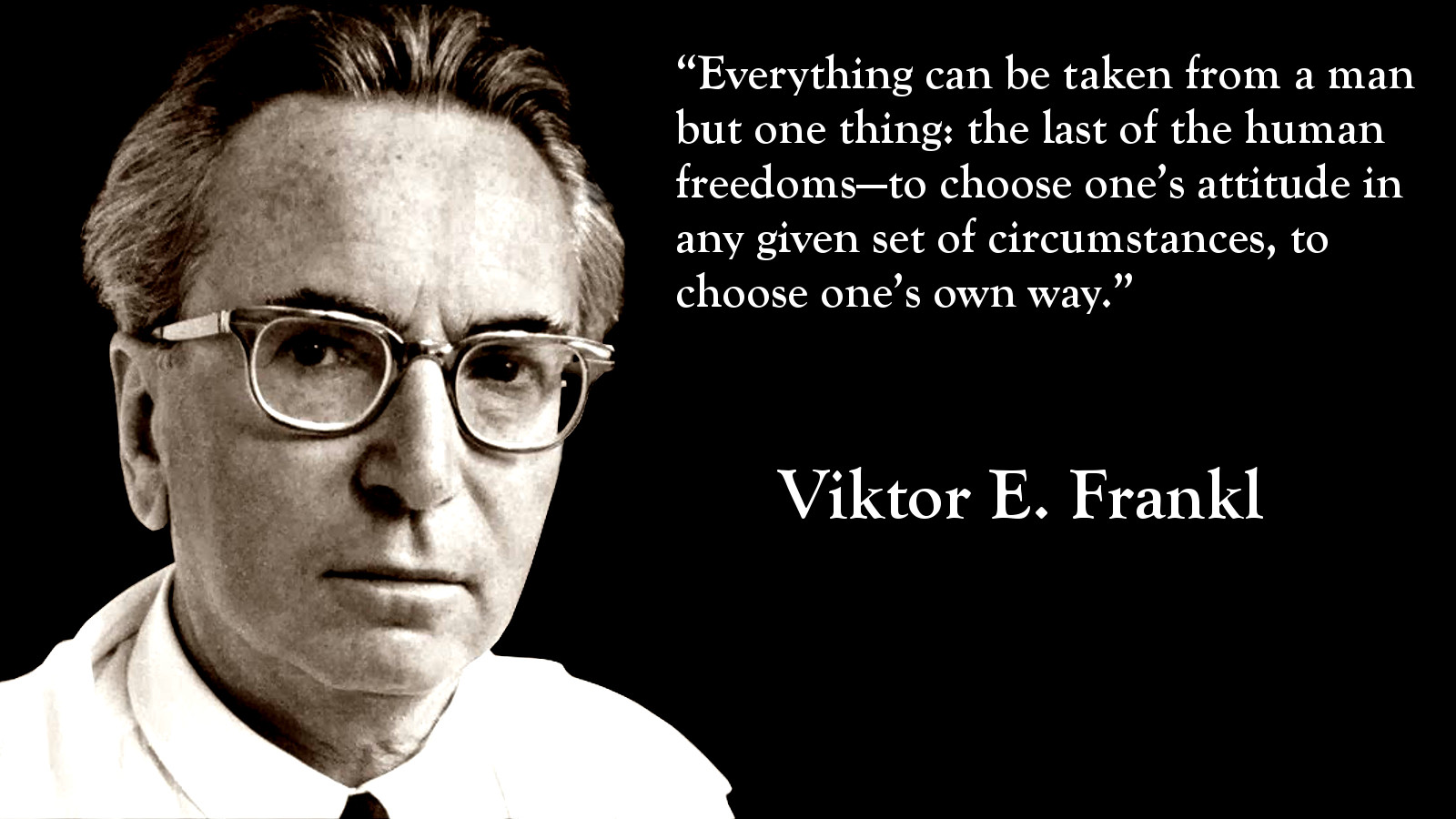
    In his book, Viktor Frankl states that the meaning of our life can be found through 1) work, 2) love and 3) suffering. (Not that suffering is desirable: as long as it can be avoided, we should find meaning in changing our situation for the better.) But when suffering is unavoidable, even when everything has been taken away from us, the last of our human freedoms that can not be taken away is this: the freedom to choose one’s attitude in any set of circumstances, to choose one’s own way.

    This turns around the perception of suffering from something inherently bad into something possibly beneficial. I myself have lived through trauma, transformed it and lived with the fruits of this inner work for years, but I always kept thinking: what would happen in the worst of the worst of circumstances?

    Never have I found such a clear explanation of the value of suffering as in this book, coming from the mouth of a survivor of the Holocaust – the epitome of suffrage. Paraphrased, what he argues is this:

    Suffering helps find the meaning of life

    In Frankl’s view, the will for meaning is our deepest drive (not the will for sex or fear or power, as some of his predecessors have proposed). Responding to suffering is an opportunity to give meaning to our life, and true meaning can only be found in self-transcendence.

    And there I found the answer to my MIQ, in my own understanding:

    Suffering is a means to awakening

    If we let it.

    And that is essential: we have to let it. Frankl’s invitation is to take responsability in our approach to life, where we have the opportunity to show human greatness, and to never stop making that brave choice.

    Instead of asking, “what is the meaning of my life?” we should recognize that actually life is asking this question of us. We can give our own answer by responding to our life’s circumstances in the best way we possibly can:

    “In accepting this challenge to suffer bravely, life has a meaning up to the last moment, and it retains this meaning up to the very end.”
    – From Man’s Search for Meaning by Viktor Frankl

    The psychiatrist acknowledges that not everybody in the Nazi camps has been able to transcend this amount of suffering, in fact – most weren’t. Yet the examples of some of them who did, even if only a few, are proof of our natural and true human potential.

    I would like to end with the final sentences of Man’s Search for Meaning, words that brought chills all over my body and tears in my eyes:

    “Our generation is realistic, for we have come to know man as he really is. After all, man is that being who invented the gas chambers of Auschwitz; however, he is also that being who entered those gas chambers upright, with the Lord’s Prayer or the Shema Yisrael on his lips.”

  • Stop believing your mind (read The Untethered Soul)

    Stop believing your mind (read The Untethered Soul)

    “There is nothing more important to true growth than realizing that you are not the voice of the mind – you are the one who hears it.”
    Michael A. Singer, The Untethered Soul: The Journey Beyond Yourself

    Here’s a fun exercise: write down your thoughts for a day, or even a couple of hours. Then read out loud what you’ve written down.

    It will be a dreamlike, rather incomprehensive monologue or inner conversation, a collection of words and sentences pretty random, often contradictive and colored by emotion.

    If this were a real life professional you were consulting for guidance in your life, would you be happy with their service? If this was your friend talking, would you think they are sane?

    In his book The Untethered Soul, Michael Singer helps readers let go of the sense that they are their minds, or even that they should believe their thoughts all the time. Instead, he helps them find their sense of I somewhere deeper, in a place untainted by the turbulence of life.

    Reading this book has helped me and many friends live from love, not fear, even when things get busy, messy or tough. I always recommend it to people who suffer from an overactive mind or who notice they live in their heads much of the time.

    “Do not let anything that happens in life be important enough that you’re willing to close your heart over it.”
    Michael A. Singer, The Untethered Soul: The Journey Beyond Yourself